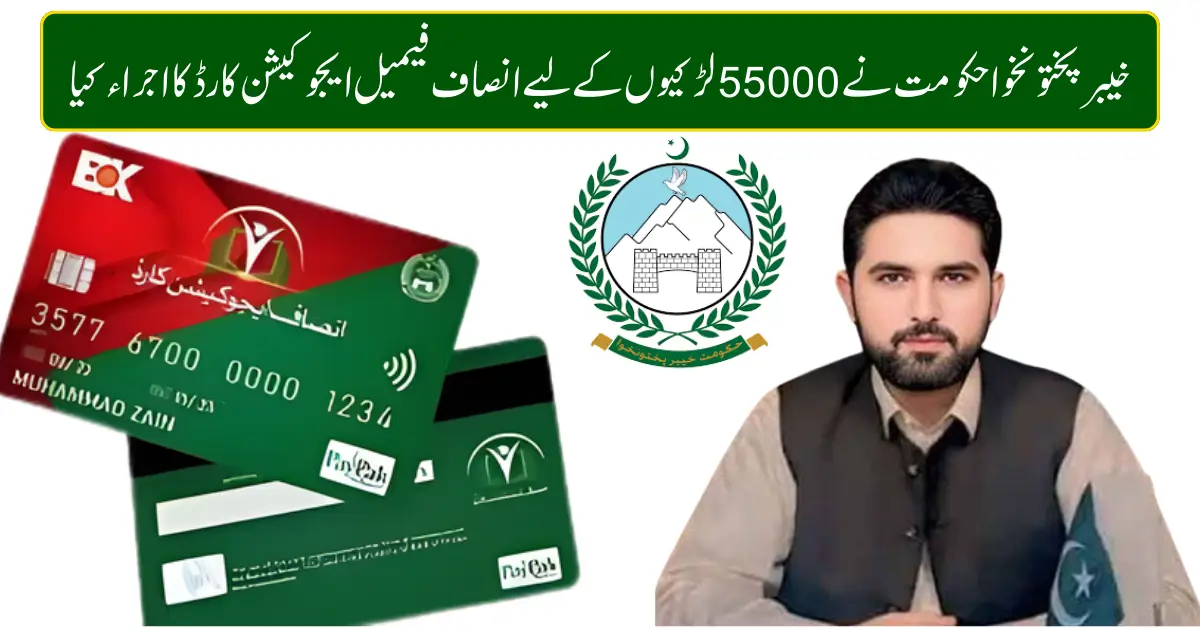
KP Introduces Insaf Female Education Card to Support 55,000 Schoolgirls Across the Province
The Government of Khyber Pakhtunkhwa has taken another major step toward strengthening girls’ education by launching the Insaf Female Education Card for 55,000 deserving students. This initiative is designed to reduce financial barriers, increase school retention, and encourage families to keep their daughters enrolled in secondary and higher secondary education.
The program reflects the province’s growing focus on social protection, human development, and equal access to education. By providing direct financial support through a transparent digital system, KP aims to ensure that talented girls are not forced to drop out due to economic hardship.
What Is the Insaf Female Education Card?
The Insaf Female Education Card is a government-issued digital assistance card that provides monthly financial support to selected female students enrolled in public sector schools and colleges across KP.
The main purpose of this card is to:
- Help families cover education-related expenses
- Reduce dropout rates among girls
- Promote continuity in secondary and higher secondary education
- Strengthen women’s participation in the future workforce
This initiative is being implemented with support from the Khyber Pakhtunkhwa Elementary and Secondary Education Department.

Who Will Benefit From the Program?
In its first phase, the program targets 55,000 girls from low-income households across urban and rural districts of Khyber Pakhtunkhwa.
Priority is given to:
- Girls enrolled in government schools
- Students from financially vulnerable families
- Orphans and children of widows
- Girls at risk of dropping out
The focus is on ensuring that assistance reaches students who need it the most.
Financial Support Details
Under the Insaf Female Education Card:
- Monthly stipend will be credited directly to the card
- Funds can be used for school-related expenses such as:
- Books
- Uniforms
- Transport
- Stationery
This direct payment model minimizes delays and ensures transparency.

Why This Initiative Matters
Girls’ education remains one of the most effective ways to improve social and economic outcomes. When girls stay in school:
- Child marriage rates decline
- Household incomes improve in the long term
- Health and nutrition outcomes become better
- Communities experience sustainable development
By launching this program, KP aligns itself with national efforts to expand social protection, similar in spirit to initiatives such as the Benazir Income Support Programme, which also focuses on direct financial assistance for vulnerable families.
Eligibility Criteria for Insaf Female Education Card
While final eligibility rules may vary by district, the general requirements include:
- Resident of Khyber Pakhtunkhwa
- Enrolled in a government school or college
- Valid B-Form or CNIC (for older students)
- Family income below the specified threshold
Schools and district education offices play a key role in identifying and verifying eligible students.
How the Selection Process Works
The selection process is designed to be transparent and data-driven.
- Schools compile a list of eligible students
- District education authorities verify records
- Approved lists are forwarded for final confirmation
- Cards are issued to selected students
- Monthly stipend begins after activation
This system reduces political influence and ensures fairness.
Digital and Transparent Payment System
The Insaf Female Education Card operates through a digital payment mechanism. Each card is linked to the student’s identity and verified through official records.
Benefits of the digital system include:
- Reduced risk of fraud
- Faster disbursement
- Clear transaction history
- Easy monitoring by authorities
This approach also prepares students for future inclusion in formal financial systems.
Expected Impact Across KP
The program is expected to create long-term positive outcomes, such as:
- Increased enrollment of girls at secondary level
- Lower dropout rates in underdeveloped districts
- Improved academic performance
- Stronger female participation in higher education
Over time, this initiative could become a model for other provinces to follow.
Future Expansion Plans
The KP government has indicated that, based on performance and budget availability, the program may be expanded to:
- Include more students
- Cover higher education levels
- Increase stipend amounts
- Integrate with other youth development schemes
Such expansion would further strengthen the province’s education ecosystem.
Role of Parents and Schools
Parents and schools are encouraged to:
- Ensure girls attend school regularly
- Maintain accurate student records
- Inform students about card usage rules
- Report any issues to district education offices
Active community participation is essential for the program’s success.
Frequently Asked Questions
Is the Insaf Female Education Card a loan?
No. It is a grant-based stipend that does not require repayment.
Can private school students apply?
Currently, the program focuses on public sector institutions.
How long will the stipend continue?
Support is provided as long as the student remains enrolled and meets attendance criteria.
What if a card is lost?
Students can report the issue to their school or district office for replacement.
Conclusion
The launch of the Insaf Female Education Card marks an important milestone in Khyber Pakhtunkhwa’s journey toward inclusive and equitable education. By supporting 55,000 girls with direct financial assistance, the province is investing in a future where more young women complete their education, enter skilled professions, and contribute to economic growth.
This initiative is not just about financial aid—it is about creating opportunity, dignity, and long-term change.